
Calathus melanocephalus
I thought this was quite a distinctive beetle but I have recently discovered that Calathus cinctus can look more similar than I had appreciated. I have now re-identified some of my earlier records of Calathus melanocephalus and deleted those from this page.
 (1).jpg)
 (2).jpg)
Calathus melanocephalus, Wendling Beck Environment Project (Norfolk, UK), 2nd to 7th November 2022
This was one of three similar Calathus beetles that I found by suction or pitfall trap over a couple of days at two nearby sites. All three had reddish pronotum contrasting with blackish head and elytra and on that basis I intially identified all three as melanocephalus. For some reason I stalled over one of them, a niggling doubt prompting me to investigate further. I ran a photo past ObsID and it was 100% confident it was cinctus. The only differences between these two species given in Hackston's key are that the pronotum is reddish brown rather than reddish, which doesn't seem to me to be an easy call in most cases, and the head and elytra being a more sombre brown on cinctus vs. black on melanocephalus. On that basis I was not at all convinced that Obs ID was correct (it often isn't!), but I turned to Duff to see if that helped clear things up. Duff doesn't differentiate on pronotum colour (calling both rufous) but agrees that the head and elytra should be black on melanocephalus and dark brown on cinctus. Still thinking all three were correctly identified as melanocephalus I checked the elytral humeri as Duff also says these are denticulate on melanocephalus and toothless on cinctus. One of the three (the one below) had clearly denticulate humeri but neither of the others did. Moreover I could now see that the two toothless individuals also had proportionately longer elytra and that, according to Duff, was another difference between cinctus and melanocephalus.
Now suspecting that ObsID might actually have been correct, I dissected all three and confirmed that the one with toothed humeri and shorter elytra, below, was indeed melanocephalus, the one that had originally prompted me to check it was female so not genitalically confirmable, and the other one was indeed a male cinctus. At this point I searched the internet for photos of Calathus cinctus and discovered that individuals with almost black heads and elytra seem to be quite frequent.
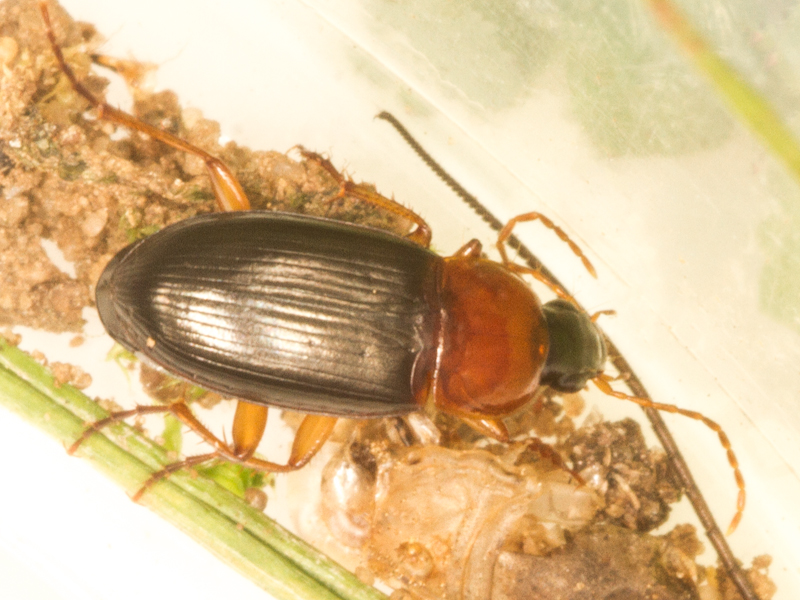
Calathus melanocephalus, Wendling Beck Environment Project (Norfolk, UK), 25th-26th September 2025
Here are the median lobes and right parameres for the two males - in each case Calathus cinctus is on the left and the above Calathus melanocephalus is on the right.
 & Calathus melanocephalus, Gorgate (R), 25-26-Sep-25 (A) (2).jpg)
 & Calathus melanocephalus, Gorgate (R), 25-26-Sep-25 (A) (1).jpg)
median lobes and right parameres of Calathus cinctus (left) and Calathus melanocephalus (right), Wendling Beck Environment Project (Norfolk, UK), 25th-26th September 2025
In view of the above experience I needed to review all of my previous records of Calathus melanocephalus, and it quickly became clear that there were more Calathus cinctus lurking among them. One or two even showed browner-toned elytra and heads, although this was not as obvious as I had previously imagined it should be. The remainder, below, are - I think - correctly identified as melanocephalus.
 (1).jpg)
Calathus melanocephalus, Wendling Beck Environment Project (Norfolk, UK), 25th-26th August 2025
 (1).jpg)
 (2).jpg)
Calathus melanocephalus, Wendling Beck Environment Project (Norfolk, UK), 4th-5th April 2025
 (1).jpg)
 (2).jpg)
Calathus melanocephalus, North Elmham (Norfolk, UK), 24th May 2019